“How many sales do you need to cover all your business costs?”
This question keeps many business owners awake at night. Your break even point – the exact moment when sales match expenses – determines whether your business is a success or ultimately will fail. For example: A local plumbing business must complete eight service calls at £625 each just to meet their monthly overhead of £5,000.
Break even calculations serve as your financial compass and helps you and your team make decisions about:
- Setting profitable price points
- Planning monthly sales targets
- Managing operating expenses
- Forecasting cash flow needs
Smart business owners use break even analysis to spot the difference between profitable opportunities and those that will eventually lose them money. Whether you run a retail store or offer professional services, knowing your break even point will help you plan your business growth.
In this guide, I’ll clearly explain the proven formulas and practical strategies to find your profit threshold and help you use this to build your roadmap for business growth.
What is break even point?
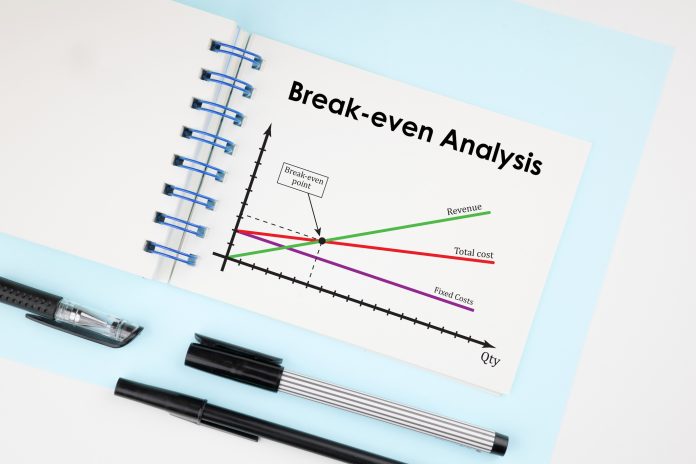
The break even point represents your business’s zero-profit milestone – the exact moment when total revenue equals total expenses, leaving you neither in loss nor in profit. Small business owners use this crucial metric to establish minimum sales targets.
Why is it important for small businesses?
This calculation reveals the minimum sales needed to keep your business open. You’ll rely on these numbers to set pricing strategies and control costs effectively. Most importantly, this analysis shows whether your business needs additional capital to sustain operations until reaching profitable territory.
Key components of break even analysis
Your break even calculation rests on three fundamental pillars:
- Fixed Costs: The expenses that stay constant month after month – think rent, employee salaries, and insurance premiums
- Variable Costs: Expenses that rise and fall with your sales volume, such as raw materials, shipping costs, and production supplies
- Contribution Margin: The money left from each sale after covering variable costs – your profit potential per unit
Common misconceptions about break even calculations
The standard calculation assumes your costs remain stable – but real business rarely works that way. Markets change, competitors also change, and seasonal patterns can throw off your carefully planned numbers. Plus, the basic formula assumes consistent pricing, overlooking common practices like bulk discounts or seasonal promotions.
These limitations don’t diminish the value of break even analysis – they simply highlight the need for regular updates and adjustments. Business owners find this tool especially valuable when planning expansion moves or launching new product lines.
The break even point formula
The break even calculation shows exactly when your business moves from loss to profit. The basic formula takes your fixed costs and divides them by the difference between your selling price and variable costs per unit.
Understanding fixed and variable costs
Think of fixed costs as your business foundation – they don’t change whether you sell one item or thousands. These include your property taxes, staff salaries, insurance premiums, and equipment depreciation. Your variable costs, however, move up and down with your sales volume. Every product you sell carries costs for materials, shipping, supplies, and direct labor. Getting these numbers right shapes your pricing decisions and profit goals.
Step-by-step calculation process
Your break even point emerges through two calculation methods:
- Break-Even Point in Units = Fixed Costs ÷ (Sales Price per Unit – Variable Costs per Unit)
- Break-Even Point in Sales £ = Fixed Costs ÷ Contribution Margin
Let’s see this in action: A business with fixed costs of £180,500 sells products at £1.19 each, spending £0.40 per unit on variable costs. Their break even point is £180,500 ÷ (£1.19 – £0.40) = 228,481 units.
Using break even calculators and spreadsheets
Microsoft Excel includes break even analysis formula so you can build a custom calculator or use ready-made templates for your calculations. These tools track your numbers in real time, automatically adjusting as your costs change.
Your contribution margin is the difference between selling price and variable costs and it’s also an important factor that shows how much each sale contributes to covering fixed costs and building future profits.
Tools for break even calculation
Smart business owners now have tools to speed up the calculations and improve accuracy that paper-based methods simply can’t match.
Break even analysis tools
Look at some of the break-even calculators on offer to help you stay profitable and generate charts and graphs show exactly where costs meet revenue, making financial planning straightforward. Try these free tools:
Good Calculators for break even
Software solutions for real-time tracking
The calculators in previous section help you plan, but you should also track your break even point on a real-time basis so you can make adjustments to your business and stay profitable. These tools pack essential features:
- Quick data gathering and number-crunching
- Easy-to-read performance dashboards
- On-the-spot profit calculations
- Custom reports for your specific needs
Together with real-time tracking, automation has simultaneously simplified and enhanced how businesses track their numbers. Connect your stock control system, accounting system and sales or pipeline tracker to generate a dashboard that shows you how your break-even point is changing. This will let you:
- Spot profit opportunities in your numbers
- Update calculations when costs shift
- Build clear reports for your team
- Watch multiple product lines at once
And if you’re using a platform with AI chat built in, you can type in questions about your break even status and get clear, fact-based answers.
Practical implementation
Your break even analysis depends entirely on the quality of your data. Tackle cost data first and start with a detailed list of every expense your business faces. Track both predictable costs like rent and insurance, plus changing expenses such as materials and labor. It’s worth adding a 5-10% buffer to fixed costs for unexpected expenses.
Essential cost categories for your list are likely to include:
- Monthly operating bills
- Material purchases
- Production equipment
- Maintenance needs
- Staff wages
- Utility costs
Regular monitoring and adjustments
Break even numbers need regular attention. Your business should check these figures whenever significant changes occur in costs or sales volumes. Regular reviews catch cost trends early, helping you spot problems before they hurt your bottom line.
Your monitoring checklist is likely to include:
- Monthly cost reviews
- Price adjustments
- Profit margin checks
- Market condition updates
Calculating your break even point
Your break-even point serves as more than just a number – it’s your business compass to help guide decisions on pricing, growth plans, and daily operations.
Use some of the free tools to help initially calculate and plan using your break even point, then look to move to automation linking your accounting, stock and sales systems to help you spot trends, flag issues, and track your progress toward profitability.
Break-even analysis works best as part of your weekly business routine. Just like checking inventory or reviewing sales figures, regular cost monitoring keeps your business on solid ground.